
Broadcasting has become increasingly dependent on technology capable of moving large amounts of video, audio, and data quickly and reliably. Whether a production involves a live sporting event, concert, news broadcast, or studio program, the quality of the transmission infrastructure can directly affect the final viewing experience. As production formats become more demanding, broadcast fiber optic systems provide a practical way to transport signals over long distances while supporting the high bandwidth that modern workflows require.
Fiber optics works by transmitting information as pulses of light rather than electrical signals. This fundamental difference gives fiber several advantages for professional broadcasting, particularly when large amounts of information need to travel between cameras, production equipment, control rooms, and other locations.
How Fiber Optic Transmission Works
Information can be converted into light and transmitted through a fiber cable. This process begins when electronic data is converted into optical signals. A light source then sends those signals through the fiber, where they travel toward their destination before being converted back into usable electronic information.
A fiber optic cable contains a central section called the core and an outer layer called the cladding. The core has a slightly higher refractive index than the cladding, which allows light to remain within the core as it travels through the cable. This happens through a phenomenon known as total internal reflection. Instead of escaping through the sides of the cable, the light repeatedly reflects within the core and continues moving forward.
This approach allows information to travel at extremely high speeds while maintaining signal integrity over significant distances. For broadcasters, that makes fiber particularly useful when equipment cannot be positioned close together or when a production requires signals to travel from a remote location back to a central facility.
Why Fiber Is Valuable for Broadcast Production
Live production environments can generate substantial amounts of data. High-resolution video, multiple camera feeds, audio channels, communications, and control information may all need to be transmitted simultaneously. Broadcast fiber optic systems can provide the bandwidth necessary to handle these demanding workflows while allowing production teams to maintain connections over considerable distances.
Another major advantage is resistance to electromagnetic interference. Because fiber carries information via light rather than electrical current, it is not affected by electromagnetic interference and crosstalk in the same way that copper-based transmission systems are. This can be especially valuable in crowded production environments containing large amounts of electrical and electronic equipment.
Fiber can also support long-distance transmission. The video’s underlying principles explain why light can travel through the fiber rather than escape it. Although signal strength eventually decreases, fiber can carry information over long distances before amplification or regeneration becomes necessary. This makes it useful for connecting production equipment separated by large venues, outdoor spaces, or remote locations.
For example, cameras positioned throughout a stadium may need to send their feeds to a production truck located outside the venue. Similarly, a concert production may require signals to travel from cameras on stage or throughout the audience area back to a centralized production position. Fiber infrastructure can provide the transmission path needed for these applications without forcing production teams to keep equipment within short cable runs.
Supporting Higher-Quality Video Workflows
The continued development of higher-resolution video has increased the importance of dependable transmission infrastructure. Moving from standard-definition production to HD and increasingly advanced formats creates greater demands on the systems responsible for transporting video.
Broadcast fiber-optic systems can help production teams meet these requirements by providing high-capacity signal transport. Fiber-optic technology is already widely used for high-speed, high-bandwidth data transmission because it can carry significant amounts of information efficiently.
Fiber’s physical characteristics can also help simplify installations. Because the technology can provide substantial transmission capacity without requiring the same type of electrical conductors used in copper systems, fiber cables can offer an efficient solution when long-distance connectivity and high data volumes are priorities.
However, fiber does require proper system planning. Signal loss can occur as light travels through the cable, particularly across very long distances. When transmission distances become extensive, repeaters or amplifiers can be used to restore signal strength. Understanding these limitations allows production professionals to design systems that maintain reliable performance from the source to the destination.
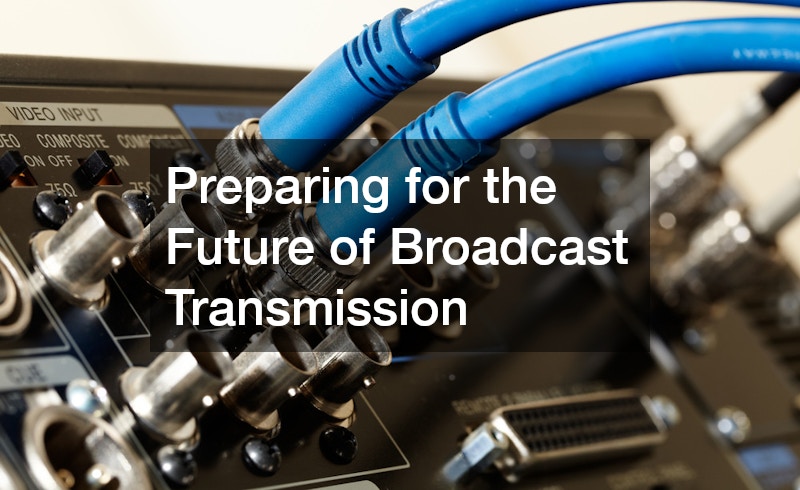
Preparing for the Future of Broadcast Transmission
A broadcast operation needs infrastructure that can support both current production requirements and future changes. Selecting the appropriate transmission technology is therefore about more than simply connecting two pieces of equipment. Factors such as distance, bandwidth, signal type, environmental conditions, equipment compatibility, and future expansion all need to be considered.
Broadcast fiber-optic systems can provide the flexibility needed for both permanent studios and temporary productions. Their ability to transport high volumes of information across long distances makes them suitable for applications where traditional connections may be less practical.
The technology also demonstrates how a relatively simple physical principle can support sophisticated modern communications. By manipulating light and exploiting the refractive-index difference between the core and cladding, fiber cables can guide optical signals over extremely long distances. What appears to be a simple strand of glass can therefore become a critical component of a complex broadcast network.
As broadcasters continue to adopt higher-resolution formats and increasingly sophisticated production workflows, reliable signal transport will remain essential. Fiber optics offers the speed, capacity, distance, and interference resistance needed to support these evolving demands. With the right equipment and system design, fiber can help production teams maintain dependable connections between cameras, studios, control rooms, production trucks, and other critical locations.
For broadcasters looking to improve signal transport and prepare their infrastructure for increasingly demanding productions, explore the professional fiber solutions available from MultiDyne and contact the team today to find the right solution for your application.